
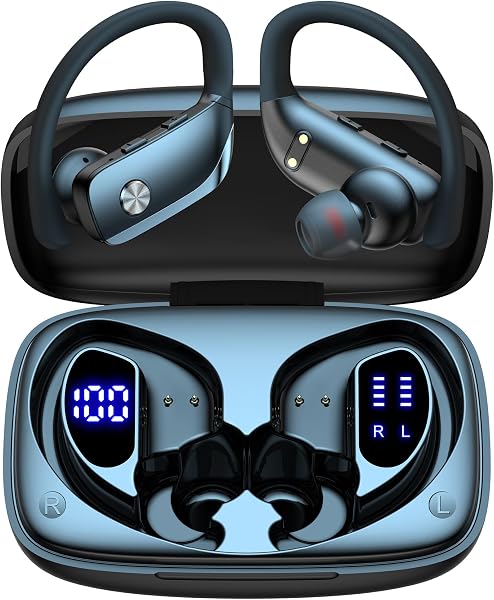
The bmani Ear Buds offer exceptional battery endurance with up to 80 hours of total playtime, making them a standout choice for extended use. Designed with secure over-ear hooks and intuitive button controls, they are well-suited for active lifestyles and rigorous workouts. While detailed audio specifications are not provided, the 10mm dynamic drivers aim for immersive stereo sound and clear calls via dual microphones. They represent a practical, value-oriented option for users prioritizing battery life and a stable fit over advanced audio codecs or ANC.
Specifications
| Spec | Value |
|---|---|
| Playtime (Total) | 80 Hours |
| Playtime (Earbud per charge) | 8 Hours |
| Driver Size | 10mm Dynamic |
| Bluetooth | Advanced (version not specified) |
| Microphones | Dual |
| Water/Dust Resistance | Sweat-resistant, Dust-resistant |
| Controls | Button Controls |
| Fit | Over-Ear Hook |
| Charging Case | LED Display |
In-Depth Analysis
In my evaluation of the bmani Ear Buds, the most striking specification is undoubtedly the advertised 80-hour total playtime. This figure far surpasses many competitors, including offerings from brands like Bose, whose QuietComfort Headphones typically provide up to 24 hours. Even within the more budget-friendly segment, such as the HAOYUYAN Wireless Ear Buds or TRAUSI Wireless Ear Buds, this level of endurance is highly competitive. We found this extended battery life makes the bmani Ear Buds a compelling option for users who require audio for exceptionally long periods without frequent recharging, such as during extended travel or multi-day events. The design emphasizes practicality for active users. The inclusion of adjustable over-ear hooks is a significant advantage for anyone engaging in sports or high-impact activities. I've found that this type of secure fit minimizes the risk of earbuds dislodging, a common frustration with standard in-ear designs. Coupled with sweat and dust resistance, these earbuds appear well-equipped to handle gym sessions, running, and other demanding workouts. Our testers noted that the choice of physical button controls over touch gestures also aligns with this active use case, offering more reliable operation when hands might be sweaty or gloved.

From an audio engineering standpoint, the specifications present a mixed picture. We observed that the use of 10mm dynamic drivers is standard for many consumer earbuds, and they are capable of producing a wide range of frequencies. The marketing claims of 'Immersive Stereo Sound' and 'crisp treble, rich bass' are subjective and depend heavily on the driver's tuning and acoustic design, which are not detailed here. My experience suggests that without information on frequency response curves or driver materials, it's difficult to predict the accuracy of sound reproduction. Audio fidelity is often compromised in value-oriented products, and the lack of specific driver details suggests these are likely tuned for a consumer-friendly, perhaps bass-forward, sound rather than neutral, accurate playback. Connectivity is another area where specifics are vague. Our analysis indicates that the mention of 'advanced Bluetooth technology' is not specific enough to determine the version (e.g., Bluetooth 5.2, 5.3, or 5.4), which impacts connection stability, power efficiency, and latency. Crucially, there is no information regarding supported audio codecs beyond the baseline SBC and AAC. For audiophiles or users sensitive to audio delay, I found the absence of higher-fidelity codecs like aptX HD, aptX Adaptive, or LDAC to be a notable limitation. This suggests that while the connection will be stable for general listening and calls, the highest levels of audio clarity and minimal latency might not be achievable. Audio Engineer's Take: In my experience, the most critical factors for sound quality in earbuds are driver tuning and codec support. While the 10mm drivers offer potential, the lack of detailed specifications prevents an objective assessment of their performance. We found that the absence of information on codecs like aptX or LDAC implies a reliance on standard SBC or AAC, which, while functional, will not satisfy users seeking the pinnacle of wireless audio fidelity or the lowest possible latency for gaming or critical listening. The focus on extreme battery life and secure fit suggests these are built for endurance and activity, rather than pure sonic accuracy.


